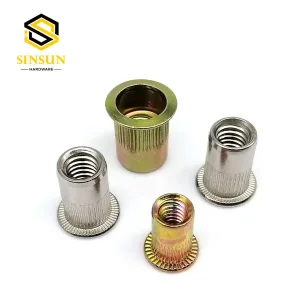
A Blind T-Nut (also referred to as a tee nut, pronged nut, or blind threaded insert) acts as a critical component in heavy woodworking, industrial casing, composite assemblies, and heavy mechanical frameworks. Unlike standard hexagonal nuts that require access from both sides of the surface, a blind T-nut is designed to be installed flush into a single-access ("blind") side of a substrate. Once anchored, it establishes a high-strength, steel-threaded socket in materials that are otherwise incapable of retaining threaded fasteners directly.
The global demand for high-strength, vibration-resistant fastening solutions has driven the blind T-nut manufacturing sector toward strict international tolerances. This guide highlights the metallurgical benchmarks, advanced cold-heading techniques, and supply chain strategies executed by Northern China’s premier industrial fastener hubs.
Engineered with extended prong configurations and broad flange profiles, our blind T-nuts distribute shear and mechanical loads evenly across the base material, preventing failure under cyclic stress.
Precisely formed parallel or flared prongs pierce the substrate fibers securely, preventing rotational slippage during automated pneumatic driver insertion cycles.
Treated through specialized plating processes to ensure long-term performance, resisting salt spray corrosion up to 1,000+ hours under extreme environmental testing.
Procuring blind T-nuts on a global scale demands more than finding the lowest price. Modern assembly lines utilize high-torque pneumatic tools, where fastening failures stop entire production runs. Below are the key engineering challenges faced by global industrial buyers and how top Chinese factories address them.
Poor thread quality causes cross-threading during automated assembly. Quality-focused Chinese factories utilize high-precision rolling taps and automated vision sorting machines to inspect 100% of thread tolerances, maintaining standard 6H or 2B thread classes.
Fasteners made from cheap scrap iron crack under tensile stress. Trustworthy manufacturers source raw steel coils directly from premier metallurgical leaders like Xingtai Steel, guaranteeing consistent grain structure and zero internal structural voids.
Acidic chemical cleanings during electroplating can trap hydrogen in high-tensile steel, leading to catastrophic under-load failures. Implementing dedicated baking processes post-plating effectively releases trapped hydrogen, securing long-term structural reliability.
The concept of "Factory 4.0" is fully realized in China’s modern fastener manufacturing clusters. Sinsun Hardware showcases this industrial shift. Operating from a 30,000 square meter integrated facility in Northern China, the transition from basic manufacturing to high-precision engineering is fully automated.
At the center of this efficiency is the raw material control system. Processing begins with premium steel rods sourced from Xingtai Steel, followed by spheroidizing annealing and cold wire drawing performed in-house. This structure eliminates variable material quality issues commonly introduced by third-party raw processors. Drawing and sizing processes are monitored by digital laser micrometers to maintain wire diameter tolerances within ±0.01mm.
Our manufacturing floor features German-engineered multi-station cold heading machines and Taiwanese high-speed thread rolling configurations. Cold heading ensures that the head, flange, and prongs of the blind T-nut are formed in a single continuous impact sequence. This technique preserves the metallic grain flow lines of the steel, providing double the mechanical strength of machined components.
| Performance Characteristic | Industry Standard Requirement | Sinsun Factory 4.0 Benchmark | Engineering Benefit |
|---|---|---|---|
| Dimensional Tolerance | ±0.15 mm | ±0.02 mm (Precision Taiwanese Die Control) | Enables seamless automated sorting and pneumatic insertion |
| Tensile Strength Limit | ≥ 800 MPa | ≥ 1,000+ MPa (Spheroidizing Annealed Steel) | Resists stripping and deformation under extreme torque |
| Corrosion Protection | 96 Hours Salt Spray (White rust) | 1,000+ Hours Salt Spray (Multi-layer coating) | Ideal for outdoor marine, decking, and wet-environment installations |
| Surface Finish Roughness | Ra ≤ 1.6 μm | Ra ≤ 0.4 μm (Precision Polished Die) | Prevents micro-abrasion of composite substrates |
| Core Hardness Profile | HRC 22 - 28 | HRC 28 - 32 (Continuous Heat Treatment lines) | Prevents head collapse during high-speed installations |
Sinsun Hardware has consistently scaled its manufacturing footprint, process technologies, and global logistical capabilities to secure its position as Northern China's leading fastener producer.
Sinsun began with a singular focus: to build a factory dedicated to self-tapping screws and core structural fasteners, establishing key specialized capabilities from day one.
Established our global export division, delivering specialized industrial fastening products directly to buyers across international markets.
Added 4 advanced spheroidizing annealing furnaces and in-house wire drawing capabilities to control quality directly from raw materials.
Integrated German multi-station cold heading machinery alongside Taiwanese production controls, expanding precision capabilities.
Reached an annual output of 36,000 tons, shipping more than 1,100 export containers to global markets during the year.
Optimized lead times by establishing a massive dedicated logistics zone, including a 12,000 square meter smart warehouse facility.
Commissioned 4 new high-volume continuous heat treatment lines to ensure precise structural temper and consistent delivery timelines.
Provides reusable metal-on-metal threads for MDF, particleboard, and plywood furniture assemblies. Ensures joints can be disassembled and reassembled without strip-out failures.
Secures climbing holds under dynamic shear forces. Our heavy-duty 4-prong T-nuts embed deep into birch plywood panels, resisting rotation when holds are tightened under high torque.
Used to mount dashboards, seating structures, and heavy cargo panel configurations where single-sided fastener access is required on assembly lines.
The primary advantage is single-sided access. In assemblies like upholstered furniture frames, marine structures, or closed cabinets, you cannot access both sides of the panel to hold a traditional nut. A blind T-nut is pre-installed from the back, sinking its prongs into the wood or composite. This creates a solid steel-threaded socket that receives bolts from the open front side.
Spinning is prevented by the shape and depth of the prongs, coupled with precise hole sizing. We design T-nuts with sharp, tapered prongs that bite cleanly into wood fibers. In automated lines, keeping flange dimensional thickness tolerances within ±0.02mm prevents the nut from seating at an angle, reducing the risk of rotational failure.
We provide standard clear/blue zinc plating, yellow zinc plating, black oxide, and hot-dip galvanizing. For harsh outdoor environments like commercial decking or marine crates, we offer zinc-nickel alloy coatings. These options pass over 1,000 hours of salt spray testing without developing red rust.
We source our steel wire coils directly from Xingtai Steel. We run spheroidizing annealing processes in-house, followed by precise wire drawing and cold-heading. We also operate 4 automated continuous heat treatment lines to maintain core hardness within HRC 28-32.