What Is a Phosphate Coated Drywall Screw?
A Phosphate Coated Drywall Screw is designed for fastening gypsum panels to wood or metal framing. Its dark phosphate finish helps reduce friction during installation. It also provides limited corrosion protection in dry, controlled interiors. The coating is not a waterproof barrier. That distinction matters.
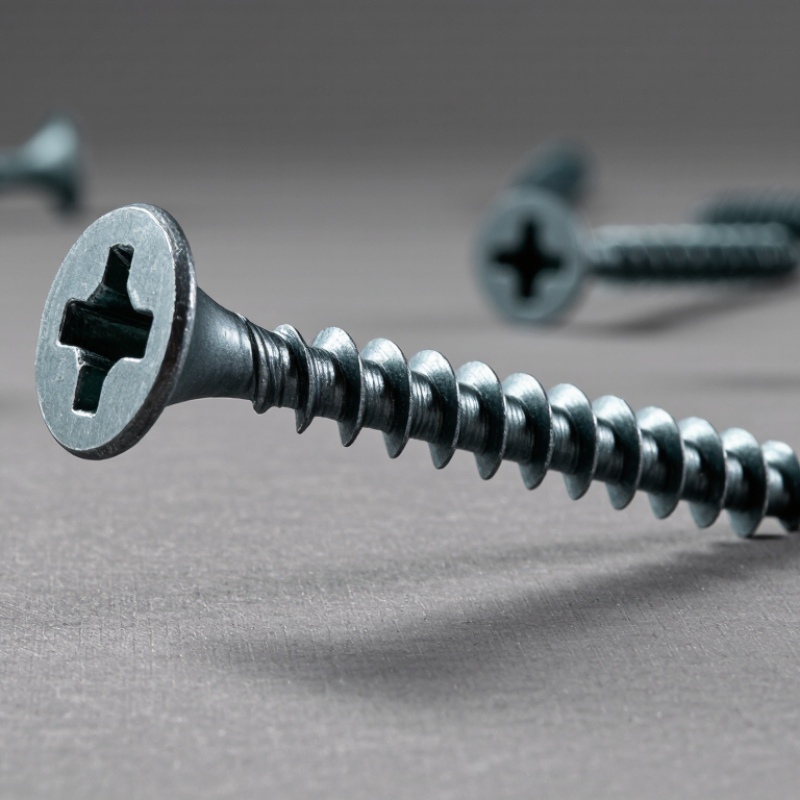
The screw usually has a sharp point, a bugle-shaped head, and a Phillips drive recess. Its head presses the drywall paper without tearing deeply into the gypsum core. Coarse threads generally grip wood studs effectively. Fine threads suit many light-gauge metal framing applications. Choosing incorrectly can cause spinning, weak holding power, or damaged board edges.
Drywall contractor and author Myron Ferguson has emphasized, “Good drywall work starts with choosing the right materials and tools.” That principle fits this fastener closely. A box of screws may look uniform, but thread type, length, point design, and coating all affect the finished wall. For example, a 1-1/4-inch screw commonly suits one layer of drywall over wood framing. The exact choice still depends on panel thickness and framing conditions.
Installation experience reveals a less comfortable truth. A coated screw cannot repair poor spacing or excessive driving pressure. The head should sit slightly below the surface, without breaking the paper. A reliable installer checks the board, framing, and screw length together. Small mistakes remain visible after finishing. Sometimes, the “right” screw is still wrong for the environment. Wet rooms, exterior exposure, and chemically aggressive conditions require different corrosion-resistant fasteners and verified manufacturer guidance.
What Is a Phosphate Coated Drywall Screw?
A phosphate coated drywall screw has a thin phosphate conversion layer over its steel surface. This coating usually appears black or dark gray. It helps reduce friction during driving and improves paint adhesion. It also offers limited protection against surface rust. Limited is the important word. This screw is not waterproof.
The typical design includes a bugle head, a sharp point, and coarse or fine threads. Coarse threads grip wood framing well, while fine threads suit metal studs. The Gypsum Association’s GA-216 guidance commonly places drywall screws about 12 inches apart on ceilings and 16 inches apart on walls. Project specifications can change those distances. ASTM C1002 provides a major industry reference for screws used with gypsum panel products, but it does not make every phosphate coated screw suitable for every condition.
On site, the correct screw should sink slightly below the drywall paper without tearing it. A damaged paper face can weaken the holding area and create a visible bump after finishing. Experienced installers often test one screw first. That small step prevents repeated mistakes.
Phosphate coating is practical, not magic. In damp rooms, exterior walls, or chemically aggressive areas, corrosion-resistant fasteners may be required. Product data sheets, framing material, and local code should guide the final choice. I would not judge quality by color alone. Two black screws can perform very differently.
A phosphate coated drywall screw is a hardened steel screw covered with a dark phosphate conversion coating. The coating improves surface protection, reduces glare, and provides a suitable base for interior finishing. It offers limited corrosion resistance and is generally intended for dry indoor drywall installation rather than damp, wet, or exterior environments.
The chart uses a relative suitability scale from 1 to 5. Phosphate coated drywall screws are highly suitable for dry interior drywall work, but their protection is limited in humid, wet, and outdoor conditions.
What Is a Phosphate Coated Drywall Screw?
How Phosphate Coating Protects and Prepares the Screw
A phosphate-coated drywall screw has a thin chemical conversion layer on its steel surface. This layer slightly improves resistance to surface rust during storage and indoor installation. It also creates a rough, paint-friendly surface. That texture helps joint compound and primer grip around the recessed screw head.
The coating also reduces friction between the screw and a driver bit. In field use, this can make installation smoother and reduce damaged heads. The benefit is practical. Less slipping means fewer visible marks on drywall. However, phosphate is not a waterproof barrier. These screws are generally intended for dry interior spaces, not constant humidity or exterior exposure.
Corrosion control matters. The NACE IMPACT study estimated global corrosion costs at about 2.5 trillion dollars, or 3.4% of global GDP. That figure shows why even small protective layers deserve attention. ISO 9227 salt-spray testing can compare coating performance, but it cannot predict every jobsite condition. Real results depend on humidity, storage, cut edges, and contact with other metals.
There is a limitation.
A darker finish does not automatically mean better protection. I have seen installers treat appearance as a quality test, which is unreliable. The screw’s substrate, coating thickness, driving method, and room conditions all influence service performance. For damp areas, the specification should require a more suitable corrosion-resistant fastener.
A phosphate coated drywall screw has a dark, textured surface designed for interior fastening. The coating helps reduce friction during driving and improves paint adhesion around the screw head. Its fine threads grip gypsum board and light-gauge metal framing effectively. This matters on busy installation sites.
The sharp point starts quickly, while the bugle-shaped head helps seat the screw without cutting deeply into the paper face. These features support a clean, slightly recessed finish for joint compound. The coating also provides limited corrosion resistance in dry indoor conditions. It is not a waterproof barrier. That limitation is easy to miss.
For practical installation, use a bit that fits the recess firmly and set the driver clutch carefully. Excessive pressure can tear the drywall paper and weaken the holding area. Underdriving leaves the head exposed and creates extra finishing work. A phosphate coated screw may perform well in normal rooms, but damp locations require a more suitable fastener. Check the substrate, expected humidity, and applicable construction requirements before choosing. Small checks matter.
What Is a Phosphate Coated Drywall Screw?
A phosphate coated drywall screw has a dark surface treatment that improves grip and offers limited corrosion protection. It is mainly designed for dry, indoor construction rather than exposed or damp locations. During drywall installation, the sharp point enters framing cleanly, while the bugle-shaped head sits slightly below the panel surface. This creates space for joint compound without tearing the paper face.
Common Applications and Compatible Drywall Materials
These screws are commonly used to attach gypsum drywall panels to wooden studs, ceiling joists, and light-gauge metal framing. Coarse-thread versions usually hold well in wood because their deeper threads bite into the fibers. Fine-thread versions are better suited to metal studs, where aggressive threading can reduce slipping. They work with standard gypsum wallboard, moisture-resistant interior panels, and many ceiling boards. However, they are not automatically suitable for cement board, exterior sheathing, or wet rooms. Those materials may require specialized corrosion-resistant fasteners. The coating is helpful, not magic.
Tips: Match screw length to panel thickness and framing depth. Keep the head just below the surface. Do not break the paper. A screw gun with adjustable depth control improves consistency. I have found that overdriving screws causes more repair work than slow driving. Still, local material instructions should guide the final choice, because panel composition and site humidity can change performance. Check for damaged coating before installation.
| Screw Type or Feature | Typical Application | Compatible Drywall or Substrate | Common Size or Thread Guidance | Important Characteristics | Use Limitations |
|---|---|---|---|---|---|
| Coarse-thread phosphate drywall screw | Attaching gypsum panels to wood framing in interior wall and ceiling assemblies | Standard gypsum board, lightweight gypsum board, and many fire-resistant gypsum panels | Often about 1-1/4 in for a single 1/2 in panel; select length to provide adequate framing penetration | Deep, aggressive threads provide strong purchase in wood; bugle head helps seat the screw without unnecessarily tearing the paper face | Intended primarily for dry interior areas; excessive driving can break the gypsum surface and reduce holding performance |
| Fine-thread phosphate drywall screw | Fastening gypsum panels to light-gauge steel studs or metal framing | Standard, lightweight, fire-resistant, and sound-rated gypsum panels when approved by the assembly requirements | Commonly selected in approximately 1 to 1-1/4 in lengths for single-layer panels; length varies with panel thickness and steel gauge | Fine threads reduce interference in thin metal; a sharp point is generally used for lighter-gauge framing | For heavier or thicker steel, a self-drilling point and a fastener approved for the framing system may be necessary |
| Bugle-head phosphate screw | General-purpose installation of drywall panels where a flush, slightly recessed finish is required | Paper-faced gypsum wallboard and many fiberglass-faced interior gypsum panels | Length should be based on panel layers and framing depth; the screw should not penetrate excessively beyond the framing | The concave head distributes pressure around the hole and supports joint-compound finishing | Not designed to act as a structural wood screw or to secure heavy fixtures without suitable blocking or anchors |
| Sharp-point phosphate drywall screw | Routine fastening to wood studs and thin-gauge metal framing | Regular gypsum board, moisture-resistant gypsum board for approved interior locations, and ceiling panels | Available in several lengths; choose a length that penetrates the framing sufficiently while avoiding unnecessary protrusion | The sharp point starts easily and is suitable for many common interior drywall fastening tasks | A sharp-point design may be unsuitable for thicker steel framing where a drilling point is required |
| Self-drilling phosphate drywall screw | Installing gypsum panels over metal studs or tracks that require the screw to drill through the framing | Gypsum panels used with compatible light-gauge steel framing systems | Select the point style and length according to the steel thickness, panel layers, and fastening schedule | Drill-point geometry can reduce the need for a pre-drilled pilot hole in suitable metal framing | The drilling capacity is limited; verify the fastener specification before using it on thick structural steel |
| Phosphate screw for multiple drywall layers | Securing two or more layers of gypsum board in fire-resistance, acoustic, or shaft-wall assemblies | Multiple layers of standard, fire-resistant, abuse-resistant, or sound-rated gypsum panels when permitted by the tested assembly | Longer screws are required; the selected length must account for all panel layers and the required framing penetration | Thread and length must match the framing and the assembly’s fastening schedule | Do not substitute fastener types or spacing in a rated assembly without confirming the applicable construction specification |
| Phosphate-coated drywall screw | Interior drywall installation, panel repair, partition construction, and ceiling work | Most interior gypsum-board products compatible with mechanical fastening | Common diameters are around No. 6 or No. 8; length depends on panel thickness, framing material, and number of layers | The dark phosphate finish improves handling and provides limited corrosion resistance while offering a suitable surface for joint compound | Phosphate coating is not equivalent to corrosion protection for exterior, continuously damp, wet, or chemically aggressive environments |
| Fastener selection for cement board or exterior sheathing | Wet-area backer-board installation, exterior sheathing, or attachment where enhanced corrosion resistance is required | Fiber-cement board, cement backer board, exterior gypsum sheathing, and other specialty panels only when the specified fastener is approved | Use the length, head style, point, and corrosion class required by the panel manufacturer or construction specification | Specialty screws may have enhanced coatings, corrosion-resistant alloys, or cutting ribs suited to harder boards | A standard phosphate-coated drywall screw is generally not the correct choice for wet locations, exterior exposure, or cement-based boards |
General selection note: Choose the screw thread, point, length, spacing, and corrosion protection according to the framing material, panel thickness, environmental exposure, and applicable building or assembly requirements.
What Is a Phosphate Coated Drywall Screw?
How to Select, Install, and Maintain These Screws
Phosphate coated drywall screws have a dark, thin surface treatment that improves handling and provides limited corrosion resistance. They are designed mainly for dry interior walls and ceilings. The coating is not a waterproof barrier. Avoid using these screws in bathrooms, exterior assemblies, or areas exposed to persistent moisture.
Choose the screw according to the framing material and board thickness. Coarse threads usually grip timber studs, while fine threads suit light-gauge metal framing. Select a length that penetrates the stud securely without striking hidden services. A bugle-shaped head should sit slightly below the board surface. Do not bury it deeply. The paper face must remain unbroken. A screw gun with an adjustable depth stop makes this easier. Keep the tool straight, and drive at moderate speed. A tilted screw can tear the gypsum core.
During installation, check every screw by touch and sight. Proud heads may show through paint, while overdriven heads weaken the fixing. I have seen rushed repairs fail because the installer trusted speed more than depth control. That mistake is easy to repeat. Remove damaged screws and replace them with new, properly sized fasteners. Store unused screws in a dry container, away from concrete floors and condensation. Inspect exposed fixings during renovations. Rust staining, looseness, or a cracked board signals a problem. Phosphate coated screws are practical, but only within their intended dry-service limits.
It is a steel screw with a thin phosphate conversion layer. The finish usually looks black or dark gray. It suits dry interior walls and ceilings.
It reduces driving friction and helps prevent minor surface rust. Its textured surface also helps joint compound and primer adhere. The protection is limited.
No. Not waterproof. It should not face constant moisture, exterior exposure, or chemically aggressive conditions. Damp areas may require corrosion-resistant fasteners.
Coarse threads usually grip timber framing effectively. Fine threads generally suit light-gauge metal framing. Match the screw length to the board and framing thickness.
The bugle head should rest slightly below the drywall surface. Do not tear the paper face. A damaged paper layer weakens the fixing and may create a visible bump.
Keep the driver straight and use moderate speed. An adjustable depth stop can prevent overdriving. Testing one screw first sounds minor, but it prevents repeated errors.
Keep them in a dry container. Avoid concrete floors and condensation. Moisture can begin rusting before installation, even when the screws look acceptable.
No. Color alone is unreliable. Coating thickness, steel quality, driving method, and room conditions all affect performance. I would not trust appearance alone.
Watch for rust stains, loose fixings, cracked boards, or raised heads. Remove damaged screws and install correctly sized replacements. Rushed repairs often fail.
A Phosphate Coated Drywall Screw is a specialized fastener designed for securing drywall panels to wood or light-gauge metal framing. Its dark phosphate coating creates a thin protective layer that helps reduce surface oxidation during storage and normal indoor use while improving the screw’s ability to hold drywall compound or paint. The coating also provides a slightly textured surface, supporting smooth installation and a secure connection between the screw head and the panel.
These screws are commonly used with gypsum board, plasterboard, and other interior wall or ceiling materials. Important features include a sharp point, a fine or coarse thread matched to the framing material, and a countersunk head that can sit slightly below the drywall surface for easy finishing. Selection should consider screw length, thread type, panel thickness, and the framing structure. During installation, use controlled driving pressure to avoid damaging the paper face or over-penetrating the board. Store the screws in a dry area and replace any heavily corroded or damaged fasteners.